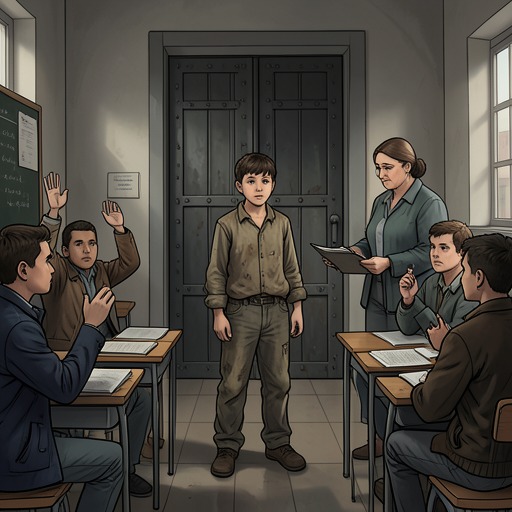
Brendan Quigley
Angela's AshesBrendan Quigley, known to his classmates as “Question Quigley,” is distinguished by a persistent willingness to ask what lessons leave unexplained. His questions expose two sharply different forms of classroom authority: Mr. Benson treats inquiry as disobedience and answers it with violence, while Mr. O’Neill initially welcomes Quigley’s questions before faltering when one connects Euclidean geometry to German bombing. Quigley’s small but consequential role shows how a schoolboy’s curiosity can reveal the limits of rote instruction and the risks of speaking in a system governed by masters and sticks.
Identity and the First Questions
In Mr. Benson’s class, Quigley is already recognized as the boy who cannot help asking questions. While the master insists that the boys memorize Catholic doctrine and prayers, including the Ten Commandments, Quigley raises his hand to ask what sanctifying grace is. The question is not an attempt to refuse the lesson; it asks for the meaning of a term the master demands the class absorb. Mr. Benson responds that its meaning is none of Quigley’s business and warns the class against asking questions. The exchange establishes the gap between learning doctrine by rote and being allowed to understand it.
The narrator’s classmates watch when Quigley raises his hand again, wondering whether he is courting disaster. During a rebuke of boys who go to the cinema, Mr. Benson uses the word “henchmen.” Quigley asks what it means. The word is ordinary vocabulary within the master’s denunciation, but the question makes the authority behind the denunciation suddenly visible: the schoolboy is expected to receive the language without asking to have it explained.
Punishment and Classroom Authority
Mr. Benson’s answer to Quigley’s second question is physical. His face reddens; he drags Quigley out of his seat, flogs him across the shoulders, bottom, and legs, and pulls him by the collar to the front of the room. Quigley is left shaking and crying, apologizing to the master. The sequence makes the cost of curiosity concrete: a question about a word becomes an occasion for public humiliation and beating.
This punishment belongs to a broader classroom order in which the master claims the right to determine what pupils need to know and when they may speak. Mr. Benson demands mastery of catechism, prayers, and religious formulas, yet rejects a request to clarify one of the concepts he invokes. Quigley’s repeated questions expose that contradiction without delivering a speech against it. His role is defined by the questions themselves, and by the escalating force used to stop them.
Euclid, War, and a Different Master
In the fourth class, Quigley encounters a markedly different response. Mr. O’Neill, nicknamed Dotty, writes “Euclid, geometry, idiot” on the blackboard and threatens punishment for anyone who interferes with the words. He tells the boys that anyone who does not understand Euclid’s theorems is an idiot. Quigley raises his hand to ask what a theorem is and what Euclid is. Instead of striking him, Dotty smiles and recognizes that he has asked two questions at once.
That welcome is not simply a release from classroom discipline. Dotty becomes the master’s apparent favorite, and the other boys notice that Quigley can ask questions they do not feel able to put to the teacher themselves. They urge him to ask what use Euclid and its endless lines can have while German forces are marching and bombing. Quigley does not want the role: he says he never asked to be the master’s pet and fears Dotty may attack him if he puts the question. His classmates threaten to attack him themselves if he refuses, making his position uncomfortable whichever way he turns.
The next day, Quigley asks the question the boys have pressed upon him: what use are Euclid and its lines when the Germans are bombing everything that stands? Dotty’s smile disappears. He answers that Euclid makes the Messerschmitt’s flight and the Spitfire’s movement possible, and argues that geometry brings grace, beauty, and elegance. The reply connects abstract mathematics to wartime aircraft, but it also shifts the question: Quigley asks about the use of geometry amid destruction, while Dotty defends its place in the creation of machines and in an ideal of beauty.
Narrative Role and Significance
Quigley’s questions repeatedly test whether a school’s declared purpose—religious instruction or mathematical learning—can withstand a child’s request for meaning. Under Mr. Benson, inquiry is explicitly forbidden and punished; under Dotty, it is initially indulged, then becomes difficult when it brings the war into the classroom. The contrast does not make the second classroom wholly safe: Quigley fears violence, and his classmates enlist him as their spokesman through pressure of their own.
The episodes also make Quigley a conduit for the other boys’ doubts. They rely on him to ask what they fear to ask, first because they see him as the teacher’s pet and later because the question about bombing is theirs as much as his. He is neither presented through an extensive personal history nor given a separate resolution in these scenes. Instead, his distinctiveness lies in the recurring act of asking—and in the different forms of authority, fear, and explanation that act brings into view.